Pages

Saturday, 23 March 2013

Polymorphism of Cnideria

Introduction :- 


Polymorphism is a phenomenon of existance of different physiological and morphological forms represented by an extensive range of variations.
To define in other way, polymorphism means the existance of individuals(zooids) of a single species in more than one forms and functions.


Theories of Polymorphism :- 


Various theories have been put forward to explain the phenomenon of polymorphism, of these the important theories are-

(i) Poly Organ Theory :- 


Huxley & other suggested that each polymorphic is an individual member, of which polyp & medusa budded of as organ.


(ii) PolyPesson Theory :-  


This theory suggest that the cniderian colony is made up of independent & separate individuals which remain inorganic connections, with one another. This theory hold that zooids are separate individuals.


(iii) Medusa Theory :- 


This theory advocates that primitive zooids of the polymorphic colony was a Medusa which produce other Medusa by budding. Medusa possess locomotary and reproductive power. This theory holds that different organs of the colony are nothing but to time from their attachment.


(iv) Neoteny Theory :- 


Polymorphic colony arrows by neoteny and having the power of reproduction in larval conditions and there by specialization of zooids takes place.


Significance of Polymorphism :-

(i) Division of labour (function) due to lack of organs and low level of organization. Polyp zooids are concerned with food capture, feeding, nutrition, respiration, excretion, asexual reproduction etc.
and medusoid zooids are involved with sexual reproduction, protection, floating etc.

(ii) For more security, food gathering & distribution of individual.

(iii) Due to metagenesis i,e alternation of sexual & asexual stages of life cycle enhance the survival & rejuvenation of genetic materials.

       Polymorphism is the most characteristic feature of colonial Cniderians. Entire polymorphic diversities present in a species of colonial cniderians can be reduced into two zooids the polyp & medusa, which remain in organic connection with one another.

In the class Hydrozoa polypoid & medusoid forms is predominant while in class Actinozoa, zooids are exclusively polypoid. Extreme specialization of forms is exhibited by the members of the order Siphonophora of the class Hydrozoa. Their colonies exhibit highest degree of Polymorphism.  



Wednesday, 20 March 2013

Metamerism in Annelids


Definition :-


Metamerism is a type of body segmentation in bilateral animals(such as Annelids) which involves a longitudinal division of the body into a Linear series of similar section of parts.
Each section or part is called a segment or somile or metamere. In annelids each segment is demarcated externally by an anterior and a posterior groove.


Metamerism in Animal Kingdom :- 


(i) Metamerism encountered for the first time in annelids.

(ii) Apart from this it is also found in Arthropode and vertebrate and one group of mollusca (monoplacophora).

(iii) Tape worms show pseudometamerism or strobilization, which is not true metameric segmentation.


Characteristics of Metamerism :-


(i) Each metamere repeats were some all of the various organ unit.

(ii) The organs of mesodermal origin are so arranged.

(iii) The primary segmental divisions are the body wall musculature and sometimes the coelom.

(iv) This in turn imposed a corresponding metamerism, the nerves, blood vessels, excretory organ etc.

(v) Longitudinal structures such as gut, principle blood vessels and nerves extend the entire length of the body passing the successive segments while other structures such as gonads are repeated in each or few segments.

(vi) Metamerism is always limited to the trunk region. The head or acron represented by prostomium (bearing the brain and sense organs) & the pygidium (bearing the anus ) are not metameres.

(vii) Metameres in annelids are essentially alike & complete externally & internally.


(1) Pseudometamerism Theory(Hyrnan,1951 Gardrich) :- 


(i) Firstly repetition of body parts-muscle, nerves, nephridia, coelom blood vessels occured.

(ii) Secondly cross partition developed between them and a segmented condition obtained.

(iii) Each segment received a repeated part of each system.


Evidence :- 


(i) Serial repetion of organs (testes, yolk glands, transverse nerve connectives ) are seen in elongated turbellarians.

(ii) During the formation of somiles in larval and adult stage of some annelids, cross partition develops later.


(2) Cyclomerism Theory : ( Sedgwick,1884; Remane, 1950 ) 


(i) Four gastric or enterocoelic or enterocoelic pouches are separated from central gut.

(ii) Three pairs of coelomic cavities the protocoel, mesocoel & metacoel originate by division of 2 pouches.

(iii) Gradually protocoel & mesocoel are lost, only metacoel remain. 
Example :- Mollusca

(iv) Later division of metacoel produces primary segments.


Evidence :- 

All bilateral matazoans were originally segmented and coelomate and the acoelomate unsegmented group ( flatworm, nemerteans ) have lost these characters secondarily.


(3) Fission Theory ( Perrier, 1882) :-


(i) The ancestor animal was unsegmented.

(ii) By transverse fission during asexual reproduction produced a chain of sub individuals, which remained united end. so end due to incomplete separation.

(iii) Later those sub individuals become integrated morphologically and physiologically into one complex individuality.


Evidence :- 


Occurs in some platyhelminthys and annelids today.


Opposition :-


(i) In some platyhelminthys and scyphozoans fission occurs always somewhere in the middle of the chain.

(ii) Reproduction by fission is usually confined to sessile animals, but the ancestor were probably free swimming.


Significance :- 


(i) It has provided effective locomotory mechanism coordinated contraction along body generates efficient body undulating movement.

(ii) Fluid filled coelomic compartments provide hydro static skeletons for burrowing. Different turger pressure  
are effected by flow of coelomic fluid from one part of the body to the other.

(iii) Different segments can be specialized for different functions- which leads to the development of organization. It is not clearly marked in annelids, but well developed in arthropods. example- Spermatheca, clitellium are involved with reproduction, thus regional specification of the body with proper division of labour.


Tuesday, 19 March 2013

Introduction & Types of Metamerism


Introduction :-


In some animals, the body is divided into a series of compartments arrange one behind to the other. These compartments are called segments or somites or metameres. The Linear arrangement of segments one behind the other is called Metamerically segmented. 

Example :- Annelida, Arthropoda & Chordata . 


Types of Metamerism :- 


(i) True Metamerism :- 


True Metamerism is found in Annelids, Arthropods & Chordates. In true metamerism, the segmentation of the body is based on the segmentation of mesoderm. New segments are formed at the posterior end (in front of the anal segment ). Hence the youngest segments occur at the anterior end. The segments work in co- operation with all other segments.

(ii) Pseudo Metamerism / Superficial Metamerism :-  


Pseudo metamerism is exhibited by tape worms(Platyhalminthes). Here the segmentation of the body is based on the segmentation of ectoderm. New segments are formed at the anterior end (just behind the scolex). Hence the youngest segments occur at the anterior end & the old segments occur at the posterior end. The segments works as independent units. These is no co-operation between the segments.


(iii) Homonomous Segmentation :- 


If all the segments of an animals are identical, the segmentation is called homonomous segmentation. The homonomous segmentation is not found in any existing animal as at least a few of the anterior segments are always specialization is called Cephalization. The closest approach to homonomous segmentation is found in some polychaetes in which all the segments between the head and the anal segment are alike-Homonomous segmentation is a primitive condition.


(iv) Heteronomous Segmentation :-   


If the segments are dissimilar, the segmentation is called Heteronomous segmentation. 

Examples :- Arthropods & Chordates.


(v) External Metamerism :- 


In Arthropods the metamerism is external. Internally the segments are not marked by partitions.


(vi) External & Internal Metamerism :- 


In Annelids the segmentation is marked externally as well as internally. Internally, the segments are separated by transverse partition called Septa.


(Vii) Complete Metamerism :- 


When segmentation is seen in all the organs, the metamerism is called Complete Metamerism.

Example :- Annelida


(viii) Incomplete Metamerism :- 


When segmentation is not seen in all organs, the metamerism is called Incomplete Metamerism.

Examples :- Arthropoda & Chordata


Sunday, 10 March 2013

Classification of Phylum Arthropoda


Phylum :- Arthropoda


Characters :- 

(i) A pair of externally jointed appendages is usually present in each segment.

(ii) Body is externally covered by thick, tough & chitinous cuticle, forming the exoskeleton.


SubPhylum :- Crustacea


Characters :- 

(i) Head bears five pairs of appendages which comprises of two pairs of antennae & two pairs of maxilla.

(ii) Respiration usually through gills.


Class :- Branchiopoda


Characters :- 

(i) Trunk appendages are flattened leaf like structure.

(ii) Coxa is provided with a flattened epipod.


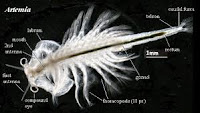
Examples :- Triopes(tadpole shrimp); Daphnia; Artemia;


Fig :- Triopes
Fig :- Daphnia
Fig :- Artemia


Class :- Ciripedia


Characters :-

(i) Body enclosed within a bivalve carapace.

(ii) Body is poorly segmented & most lack abdomen.


Examples :- Lepas; Balanus; Sacculina;


Fig :- Balanus
Fig :- Lepas


Fig :- Sacculina


Class :- Malacostraca


Characters :-

(i) Body comprises of head, an eight segmented thorax & six segmented abdomen.

(ii) The posterior thoracic limbs being walking legs, the 1st five pairs of abdominal ones forming swimming organs.


Examples :- Squilla; Hippa; Macrobrachium(prawn); Cancer;

Fig :- Squilla

Fig :- Macrobrachium


SubPhylum :- Uniramia


Characters :-

(i) Appendages are uniramous


Class :- Diplopoda


Characters :- 

(i) Presence of double trunk segments, which are either cylindrical or somewhat flattened.

(ii) Presence of calcified exoskeleton.


Example :- Julus


Fig :- Julus


Class :- Insecta


Characters :- 

(i) Head formed by the fusion of 6 segments, typically bears a single pairs of antennae & two pairs of maxillae.

(ii) The trunk in insects subdevided into three segmented thorax & an abdomen of 11 segments without walking legs.


Examples :- Lepisma(silver fish); Periplaneta; Carausias(stick insect);Bombyx; Anopheles;


Fig :- Lepisma

Fig :- Periplaneta


Bombyx
Fig :- Anopheles


SubPhylum :- Chelicerata


Characters :- 

(i) Body divided into an anterior cephalothorax or prosoma, which wholly or partially covered by a dorsal carapace  & a posterior abdomen or opsthosoma.

(ii) Lack of antennae.


Class :- Merostomata


Characters :- 

(i) A prominent spike like caudal spine or telson is present at the end of the body.

(ii) Prosoma is covered by a large, horse shoe shaped carapace.


Example :- Limulus


Fig :- Limulus


Classification of Phylum Platyhelminthes


Phylum :-  Platyhelminthes


Characters :- 


(i) Body bilaterally symmetrical & dorsoventrally flattened.

(ii) Digestive system had a single opening or mouth, that leads to a well developed gastrovascular cavity absent & anus absent.


Class :- Tubellaria


Characters :-


(i) Turbellarian are mainly free living, aquatic, but there are some terristrial sp.

(ii) Hermaphrodite, with internal fertilization.


Example :- Planeria (free living)


Fig :- Planeria
Fig :- Planeria anatomy


Class :- Trematoda


Characters :-


(i) Body cylindrical or leaf shaped & parasitic.

(ii) Body is covered by cuticle, which provides protection against host enzyme action & defence mechanism.


Examples :- Fasciola; Schistosoma; Aspidogaster;


Fig :- Fasciola
Fig :- Schistosoma


Fig :- Aspidogaster


Class :- Cestoidea


Characters :-


(i) Endoparasitic helminth, whose body is covered by a syncytial tegument.

(ii) Organs of attachment in the form of hooks & suckers are present.


Examples :- Taenia; Echinococcus;


Fig :- Taenia
Fig :- Echinococcus